Showing posts with label social networking. Show all posts

Wednesday, August 21, 2013

The SEO Benefits of Social Networking with Facebook and Google+

The best way to rank higher on a Search Engine is to build a BETTER website since SEO is not something you do 'to' a website it is how the website is built.  Strong valid content, proper META, TITLE and ALT Tags, formatting of pages and links all lead to higher rankings.  There are direct benefits from social networking since a key aspect of the Search Engine algorithms has always been 'how many links from other sites go to your website' and what is the value of those other sites.

Facebook is still the leader online with 300 times more daily traffic than Google.  Google is attempting to draw some of the user base back with Google+ social network.  Google+ is built to be Search Engine friendly with the following key attributes:

  • Content is crawled nearly instantly (it IS Google) unlike Twitter and Facebook
  • Each post has a unique URL (the first 45-50 characters of the post are the title tag)
  • Google indexes the text of every post and creates hash tags based on top keywords
  • Any links to external websites are indexed and crawled which may lead to higher page rank
  • Posts that are shared, interacted with and +1'd are seen as more important
There seems to be a correlation between highly followed and interacted 'Authors' or 'Pages' with higher value for posts made from more popular profiles or pages.  This means that an author (profile) who posts links to external websites with strong well written text that receives multiple interactions is valued higher than posts made by other profiles with little to no interaction.  


The image above shows how Google+ automatically pulls and displays the title of the post or page that was shared.  It also illustrates the 'Likes' and 'shares noted in the numeric values (+20 people and 1 share on the left and +33 people and 4 shares on the right).  Google does not directly follow the links to external URL's (website addresses) from posts but the people using Google+ do so so there is a benefit.  

The key is interaction not just posts, the value comes from connections of the connections creating exponentially vast networks who see your information as each new person '+' or shares your post.  Google owns Google+ so ALL content posted on Google+ is instantly indexed.  One study attributes Google+1's as having a slightly higher value than Facebook interaction although it is .30 for +1's and .27 for Facebook so it is a narrow margin.  


The top factor remains the quality of the web page or web site content which is where SEO is invaluable.  Building a proper website in the proper architecture with the proper content has always been the best way to rank higher on search engines.  The Internet Experts at Internet Builder Consulting have been teaching the values of Google+ for years and now the proof is in the SEO results!  If your company needs a better built website with SEO and Social Marketing for a complete solution contact the experts at Internet Builder Consulting today 816-842-7774


Tuesday, May 7, 2013

Social Networking Studies in Successful Social Marketing Timing, Posts, Interaction & Reach

Social Networking has been around for years, it transformed from a place to catch up with old friends from college or find a new band to the top online marketing platform in less than 5 years.  There are several recent studies that cover a wide range of statistical data, use and success from all of the social networks.

  • Facebook is still King:  As of April 2013 Facebook has had over 120 BILLION Impressions where the longer posts were less read and less interacted with than shorter ones in the 100-119 character range.  Posts with Questions drove interaction up 10-20% as the chart below illustrates (on the left you see the character length and the red is posts with Questions while blue is posts Without Questions).


  • Timing is Everything - the KISSMetrics study found that the best time to post on Twitter for ReTweets is 5PM.  The best time to post on Facebook for the most Shares is 1PM.  The best number of times to Tweet on Twitter is 1-2 Tweets per hour while it is best to post an average of once every two days on Facebook.  

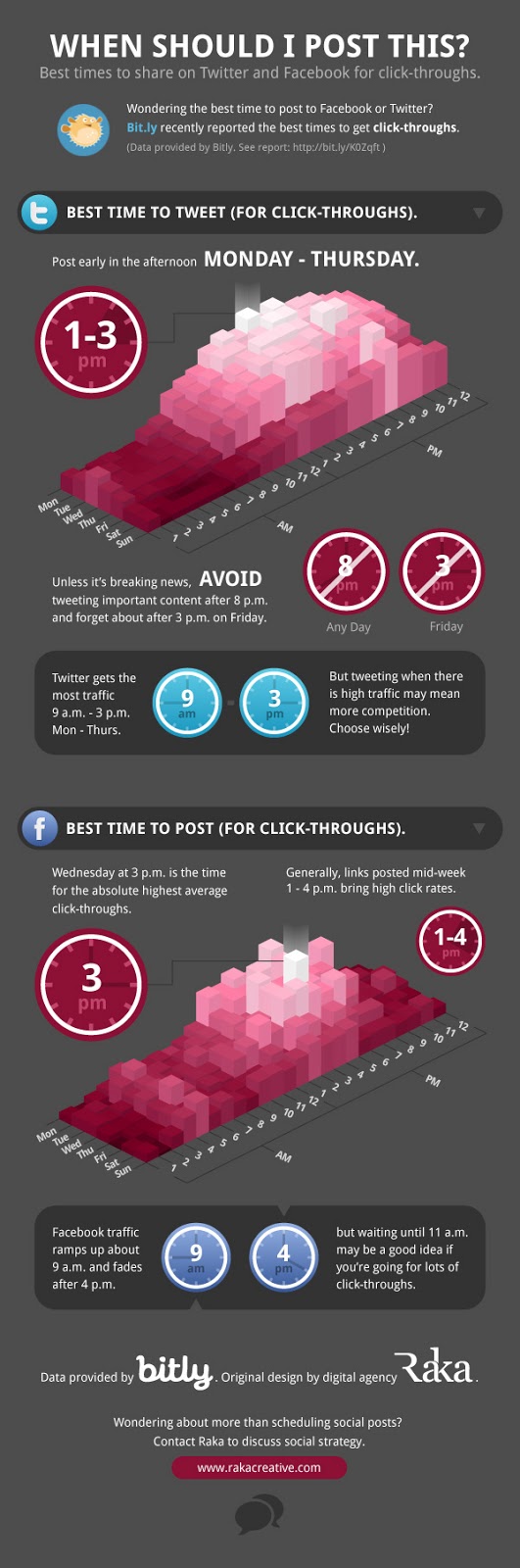
  • A study by Bit.ly and Raka found the best time to post on Twitter for Clicks is 1-3PM while the best overall time for posts on Facebook to receive the most clicks is 3PM.  Forget about Tweeting anything important after 8PM or posting on Facebook after 3PM Friday


  • A third study by Argyle Social found the best time to post on both Facebook and Twitter is 9AM-7PM.  Tweets during the Weekday have 14% more interaction than on Weekends.  The last item is the most unusual since the study found posts on Facebook have 32% more interaction on Weekends than Weekdays.  Most other studies conflict with this finding the best times to post on Facebook are during the week.  
  • 70% of Consumers Trust Recommendations on Brands from Friends:
    This is # 1 reason Facebook GraphSearch engine is going to change the way companies market online.  People like to work with, go where, be with and buy from others that they know and trust.  Facebook has more information about people than any other site on the Internet thus when someone searches for a "Pizza Place' or 'Real Estate Agent' and Facebook shows them a list of pizza places friends like or real estate agents friends work with they are highly likely to use what friends did.

  • The average 'Shelf Life' of Social Networking Links or Posts is only 3 Hours.  A study by Bit.ly tracked user posts on Facebook, Twitter, YouTube and direct on Bit.ly showing the most interaction happens within the first 60 minutes of a post.  The chart below shows the density or views/interactions on the left with the time/seconds across the bottom.  
  • Women Spend 30% more time on Social Networking websites than men.  This study by ComScore is fairly well known although I would say I am the exception to the rule since I am on Social Networks 12+ hours a day!  Some social networking sites like Pinterest have a significantly higher rate of use by women over men while others like Twitter are closer to equal.  
Statistically Social Networks are THE place to market no matter what age, gender, race or location you are targeting.  Social networks constitute over 20% of the total online time worldwide with more daily users on Facebook alone than ALL search engines combined.  The key is knowing how to setup, optimize, manage and obtain the most interaction.  If you would like an expert consultation on social networking, social media marketing, search engine optimization or simply have a question Contact the Internet Experts at Internet Builder Consulting  online or Call us at 816-842-7774.


Tuesday, April 23, 2013

Traditional Media Remains Strong, Print Advertising Reduces and Internet Marketing Shows the Highest Increase


Online ad revenues, recently reported to have increased by 15.2% in the US, predictably was the fastest-growing advertising medium on a global basis, up by 9.9%. Online ad measurement was limited to the display format, though. In the US, display ad revenues grew by 13.4%.

At 62.8% of revenues, TV accounted for easily the largest portion of global advertising spend, followed by newspapers (19.5%) and magazines (8%). Radio (5.2%) and outdoor (2.3%) each also grabbed a higher portion of spend than the internet (1.9%). The internet’s share of the pie seems quite low, and it’s unclear if that’s because it was measured in a smaller subset of markets.

Other Findings:
  • At 0.3% of spending, cinema accounted for the smallest share of advertising dollars.
  • Display ad spend in Latin America grew by 21.2%, while rising 7.2% in Europe.
  • Asia-Pacific (10.3%) and Europe (7.4%) saw above-average increases in cinema advertising.
For an expert online marketing consultation contact Internet Builder Consulting - Building BETTER Websites, SEO, Social Marketing and Online Advertising Solutions since 1995

816-842-7774 Office

Friday, August 31, 2012

Sales & Lead Generation Success with Social Marketing, Social Networking


A recent business survey reported 39% of business to business (B2B) marketers are generating leads from Facebook, and 19% generated sales from Facebook.  Business to Consumer (B2C) marketers have higher success with Facebook at 67% generating leads and 39% generating sales.

The numbers reverse on the professional oriented LinkedIn with data from the August “State of Digital Marketing 2012 Report” showing 44% of Business to Business marketers generating leads on LinkedIn and 23% generate sales.  The numbers are lower at 21% of Business to Consumer companies generating leads from LinkedIn and 9% generating sales.

Business to Consumer lead generation on Twitter is a far larger source of leads than LinkedIn with 43%,  Google+ is 15% and Pinterest lead generation is 13%.  In terms of sales the order is the same: Facebook generates 30% of sales, Twitter at 19% followed by LinkedIn at 9%, Google+ at 7% and Pinterest  generated 6% of sales generated.

An aspect of Social Marketing many companies overlook is the engagement with 90% of businesses reporting some type of engagement on social networks.  Engagement is the interaction between potential, current and past customers on social networks.  The higher the engagement rates (people who click LIKE or SHARE or COMMENT on posts) increases rankings for websites, spreads the message, brand or product to a exponentially larger audience and increases the rates of lead and sales generation.

Social Marketing is not going away, companies not activly marketing through social networks are losing out on hundreds of millions of potential buyers, sales and branding.  If your business needs an expert to build the best Social MarketingSearch Engine Optimization (SEO) or websites contact the Internet Experts at Internet Builder Consulting 816-842-7774 for a professional consultation.

Robert 'Dot Com' Jackson
Internet & Technology Expert
www.InternetBuilderConsulting.com 

Friday, January 28, 2011

Brand Management…For YOU!

In the business world there is no shortage of great companies that work everyday to manage their public image: Apple, Sony, Southwest Airlines, & Whole Foods, just to name a few. While each of these companies provide either great products, great service or both, their positive public image did not happen by accident. Between positive interactions with customers, strategic events, online media and marketing, a positive image has molded around these organizations.
Why should your own public image be any different? As more and more companies depend on alternative sources of information through the hiring process, you should be concerned about the image you are portraying, intended or unintended. What message are you sending?

As an educational exercise, search for yourself using the search engine of your choice such as Google, Bing and Yahoo. For common names, you might need to place quotes around your “name” to limit your results or add a location. Look at what the results. You might find an article about you from High School where you participated in sporting events. There might be information on a blog about services you performed a local church or food bank. You might also find pictures from Spring Break where you got a little out-of-hand. There might information available through public record about an arrest or other indiscretion. How will this affect your ability to obtain a job?
There are a few things you should know. Over the last few years, the internet community has expended dramatically. In a structured agreement, Google is now working with Facebook, Twitter and other social media websites to index the items posted and list them on search engines. The more comments and “likes” you receive for a given post increases the likelihood of those items being found through a search. So, the hilarious picture of you in Cabo with your buddies is primed to receive a number of comments and likes and will be more easily found when searched. So, how do you better manage the messages you send?
First, your personal accounts on social media sites should be set to private and use a different email address than what you give to potential employers. This will help prevent some of these pesky images and inappropriate thoughts from finding their way to a potential employer or client. Search through the first few pages of Google results and determine what needs to managed out of those results.


Next, create your online, professional profile for business (see mine here). Who needs a professional profile? Anyone in business or anyone seeking employment in the future should have a professional profile setup separate from their personal profile. Just as you want to create brand awareness for your product, you want to make potential employers aware of your endeavors. Start by creating a new profile on Facebook. Tie the profile to a separate email account and find some new friends. Join up with other professional profiles of your peers, companies, and industry professionals.

Manage the message you send to potential employers by sharing items relevant to your chosen field of employment. Find articles and narratives of interest, share your thoughts on the topic and encourage others to interact on the subject. As you send out resumes, include your professional profile to encourage employers to find this information.
Your goal should be to not only prevent a negative image through online sources, but to create a positive reputation and image for your future.

Expert Social Media Marketing contact Internet Builder Consulting

Kansas City Office 816-842-7774

Article by Steve Bertasso with contributions by Robert 'Dot Com' Jackson

Tuesday, October 19, 2010

Businesses Are Starting to See the Importance of Social Marketing

U.S. businesses assign moderate importance to social networking as a technology tool, according to a recent study from Gartner.

Email Trumps SocNets in Current Importance
Asked to rate various technology tools on a scale of 1 to 7 (7 meaning extremely important and 1 not important at all), the average respondent rated social networking tools at slightly more than 4. Social networking only ranked ahead of four other tools, all of which have a social media aspect: wikis, social tagging/bookmarking, web feeds and blogs.
Email was clearly ranked as most important, with an average score near 7. The only other tool to receive an average score of more than 6 was group calendars/scheduling. The top five tools were rounded out by web conferencing, team workspaces, and simple end-user tools.

Social Networks Hold Future Importance
Despite their relatively low rating of the current importance of social networking tools, respondents gave it the second-highest score (more than 5) when asked to rate tools for their likely increase in future importance by 2012. Only team workspaces, with an average score close to 6, were rated higher in terms of likely increase in future importance.
Surprisingly, email was last in terms of its expected change in future importance, scoring about 4.5. This suggests respondents think email will retain its current high level of importance while other tools will become significantly more valuable. No tool is seen as becoming less valuable in the next two years.

Email Completely Deployed Almost Everywhere
Email is ubiquitous with complete deployments at the organizations of 94% of the respondents; while group calendars or meeting scheduling, web conferencing, instant messaging and team workspaces are in full deployment or are being deployed at more than 50% of the organizations surveyed.
Wikis are also adopted quite widely, with more than a fifth of the respondents reporting complete deployments and almost just as many again with deployments under way. The wiki is the most readily adopted newer social software technology with full or production deployments at more than 40% of the organizations surveyed.

Desktop video conferencing, blogs and web feeds are beginning to make inroads in many organizations with about a third of them reporting these technologies as either in full or production deployments. Expertise location, social networking tools, as well as social tagging and bookmarking are less widely deployed, with less than 10% of the organizations surveyed reporting full deployments.

Most Companies Have Social Media Strategies
Three-quarters (72%) of companies currently have a social media marketing strategy, according to a new study from King Fish Media, Hubspot and Junta 42. Of the 27% without a social media marketing strategy (1% were undecided), 80% plan to have one within the next 12 months. Furthermore, only 11% of companies without a strategy definitely do not plan to implement one in the next 12 months, with 9% undecided.

Does your business or organization need expert social networking and social media marketing setup, training or consulting?  Contact the experts at Internet Builder Consulting or visit us online at http://www.socialmarketingbuilders.com/ for examples and inexpensive options to get you going online!

Robert 'Dot Com' Jackson
Internet & Social Marketing Expert
816-842-7774 Office

Tuesday, August 31, 2010

Social Networking Usage Doubles for Older Adults & 86% of 18-29 Use Social Networking

Older Adults Double SocNet (Social Networking) Use


US adults 50 and older have increased their social networking use from 22% to 42% in the past year, according to data from the Pew Internet & American Life Project.
Half of Adults 50-64 Use SocNets

Half (47%) of internet users ages 50-64 and one in four (26%) users age 65 and older now use social networking sites.
Young adult internet users ages 18-29 continue to be the heaviest users of social networking sites like Facebook and LinkedIn, with 86% saying they use the sites.
Adults 65 and Up Double SocNet Adoption

During the past year, the growth of social networking adoption among internet users ages 18-29 paled in comparison with the gains made by older users. Between April 2009 and May 2010, internet users ages 50-64 who said they use a social networking site like MySpace, Facebook or LinkedIn grew 88%, and those ages 65 and older grew 100% in their adoption of the sites; compared with a growth rate of 13% for those ages 18-29.
Older Adults Increasingly Share Daily Updates

The use of Twitter and other services to share status updates has also grown among older users, most notably among those ages 50-64. While just 5% of users ages 50-64 had used Twitter or another status update service in 2009, 11% now say they use these tools. On a typical day, 6% of online adults ages 50-64 make Twitter a part of their routine, up from the 1% who did so in 2009.
One in five (20%) adults ages 50-64 say they use social networking sites on a typical day, up from 10% one year ago. Likewise, 13% of online adults ages 65 and older log on to social networking sites, compared with just 4% who did so in 2009.
Older Adults Maintain Interest in Email, Online News

Overall, 92% of those ages 50-64 and 89% of those ages 65 and older send or read email and more than half of each group exchanges email messages on a typical day. Online news gathering also ranks highly in the daily media habits of older adults; 76% of internet users ages 50-64 get news online, and 42% do so on a typical day. Among internet users ages 65 and older, 62% look for news online and 34% do so on a typical day.
Americans Get News on Multiple Platforms

The overwhelming majority of Americans (92%) use multiple platforms to get news on a typical day, according to other recent findings from the Pew Internet and American Life Project. Americans get their news from a combination of on- and offline sources, including national TV, local TV, the internet, local newspapers, radio, and national newspapers. Six in ten Americans (59%) get news from a combination of online and offline sources on a typical day, and the internet is now the third most popular news platform, behind local television news and national television news.

To start Social Network Marketing for your business contact Internet Builder Consulting today at 816-842-7774 or visit the Social Marketing Builders website

Thursday, July 29, 2010

The Internet's Top Sources of Referral Traffic (links to your website that improve rankings)

Social Networking is about MORE than just connecting with others online.  As Internet Builder Consulting has said for years (NAHB IBS 2006, 2007 and Bob Schultz Training 2007, 2008 & 2009) an important key to online marketing is link weight and referral traffic.  A recent study we found posted on ReadWriteWeb.com showed the importance of Social Media Marketing with Facebook listed as the # 1 source of referral traffic online.

Recently the wife of a client who is now in charge of his marketing demanded all of the Social Networking accounts and Social Media Marketing be turned off and because she believed it was "worthless" even after the value of referral links was explained.  Just because someone does not understand or appreciate something does not mean it is worthless - read the article below and decide for yourself on Social Media Marketing!

Top Referrers of Traffic

For the purposes of this analysis, referrers have been segmented into different categories in order to more easily compare traffic. For example, there is no use in comparing Google to Flickr since they are not categorically related. If we're making a determination which search engine to focus on, Flickr would not be in the mix - and if we're looking for a photo hosting site, Google would not be in the mix. The four main referral categories that drive virtually all traffic are: Search Engines, Media, Social Bookmarks and Social Networks.

Social Network Referrers

Perhaps the one result that was the most surprising is the Social Networking category. Although Twitter seem to be the talk of the town, Facebook is the 900 pound gorilla when it comes to actually driving website traffic, sending nearly 7 in 10 visitors from the Social Network category. LinkedIn comes in a distant yet still respectable third place.

There is one giant unknown in this area, however. Many Twitter users access the service through applications instead of via Twitter's website. These applications do not report http-referrer data to Web servers, which makes it impossible to tell where the clicks originate. The same can be said about traffic driven by mobile apps (including Facebook).

All of the other players in the Social Networking category cumulatively amount to less than 3% of inbound website traffic.

Social Bookmark Referrers

Social bookmarking sites are also extremely sought after sources of traffic, with the highest profile member of the group being Digg. Interestingly, this is another case where a smaller source seems to receive a disproportionate amount of attention, since StumbleUpon drives nearly double the traffic to websites.

Another surprising standout in the Social Bookmark category is YCombinator's Hacker News site, which drives 12% of the traffic in this category. Reddit and Del.icio.us drive 5% and 2%, respectively. Interestingly, SlashDot (the grandaddy of them all) drives close to 0% of traffic to the sites Woopra measures - although webmasters still call the rush of traffic that can take down a website a "Slashdotting".

Search Referrers

In the Search Engine space, perhaps the only surprise is the absolute dominance of Google when it comes to actually driving traffic to websites. For example, Experian's Hitwise published a press release setting Google's share of the search market at 72% in May 2010. However, Woopra is seeing 92% of search visitors originating from Google.

This begs the question: Where does the discrepancy lie?
  • Is the Hitwise data set more representative of the whole?
  • Are there more searches taking place on other search engines that don't result in click-throughs to websites?
  • StatCounter's Global Stats seem to closely mirror Woopra's data.
Regardless of the reason, what we do know is that focusing attention on optimizing for Google search is absolutely the right thing to do. (Here's the official Google SEO starter guide.)

Media Referrers

The media referrer category is reserved for sites that focus on various forms of multimedia, including images, video and audio. These sites are often overlooked as a source of traffic because they are destination sites; however, media sites can also drive large volumes of traffic.
As an example, world-famous HDR photographer Trey Ratcliff posts travel photos on Flickr, and includes a simple link back to his site in the description of each image he posts.


This technique generated nearly 13,000 pageviews on StuckInCustoms.com in April alone.


What's more notable is that Flickr is not the dominant referrer in the Media category. YouTube drives 900% more traffic to websites than Flickr. This is accomplished the same way, via links in the description of the video.

Amazingly, 99% of referrer traffic in the Media category comes from only four providers: YouTube, Flickr, Last.FM and Vimeo.

Lessons Learned

The only question we are trying to answer with this analysis is where it makes sense to focus resources and attention in order to drive traffic. So here's what we know:
  • Search engine optimization specifically targeting Google's index is key. Working hard to satisfy other search providers probably won't pay off as much as spending the time elsewhere - like Facebook and Twitter promotion.
  • If multimedia isn't part of a site's strategy to drive traffic, it should be. Adding photos to Flickr and videos to YouTube will not only pay off in terms of adding content for your brand, but will also drive eyeballs to your site.
  • Sites that are not seeing traffic from Facebook, Twitter, or both, are missing out on a major traffic-generation source. Additionally, if the balance is not in Facebook's favor, you are likely under-utilizing this channel.
  • Don't waste time promoting your site on any Social Media network other than Facebook, Twitter or LinkedIn. Your time is better spent elsewhere (like YouTube or Flickr for example).
  • By all means, submit articles to Digg in the hopes of making it to the homepage, but more importantly make sure articles work their way into StumbleUpon, which can bring a larger, more sustained and less server-crash-creating stream of traffic.
  • For those looking to more accurately track Twitter click-throughs, some service providers such as Bit.ly enable tracking of short links. The bad news is that the tracking is not aggregated into existing Web analytics provider data.
  • This analysis doesn't take into consideration back-links (which Web authors should pursue whenever possible) because on the aggregate they do not drive global traffic. However, links from related or high-traffic sites can not only dramatically increase site traffic, they can positively impact search result listings.
Robert 'Dot Com' Jackson
Internet Builder Consulting - Building BETTER websites and Online Marketing since 1995
Social Marketing Experts and Social Networking Builders for business
816-842-7774 Office

Tuesday, June 8, 2010

How Consumers Interact with Brands on Social Networks - It Works!

Consumers DO Want Relationships according to the eMarketer.com recent study.

The social networking audience in the US has reached critical mass. eMarketer estimates that 57.5% of all US Internet users, or 127 million people, will use a social network at least once a month in 2010. By 2014, nearly two-thirds of Internet users will be on board.  Marketers have been chasing this audience for several years, but the question remains: Do consumers notice, or care?

“Those who still think that social network users are too busy engaging with friends to notice marketers must change their viewpoint,” said Debra Aho Williamson, eMarketer senior analyst and author of the new report “Brand Interactions on Social Networks.” “Brand interactions are real, valuable and growing. “
According to a February 2010 survey by Chadwick Martin Bailey, a market research firm, 33% of Facebook users have become fans of brands on the network.

Another survey, by Edison Research, found that 16% of social network users had friended brands there. And half (51%) had done so on Twitter.

Coupons remain a leading driver of brand interactions in social networks. Learning about sales and new products is also a strong motivator for people to interact with companies in social media. Beyond the tangibles, such as coupons, consumers do gain positive feelings about a brand as a result of their interactions.
Still, social networks are not seen as primary research sources when consumers are looking to buy. Although people are very inclined to take advice from friends and family about products they are interested in, they are not nearly as likely to seek out their social network friends when they are researching online.
According to a study by PowerReviews and the e-tailing group, only 3% of online buyers said they sought recommendations from social network friends first, compared with 57% who started with search engines.

“More than half of all Internet users now use social networks, and the percentage of social network users who talk about companies, either in organic conversations or on branded company pages, is growing,” said Ms. Williamson. “Consumers do pay attention and they do value positive interactions with companies.
“But while people trust their friends for advice and use social networks as part of their research process, social networks are long way from replacing search, if they ever will, as a source of information leading to a purchase.”

Robert 'Dot Com' Jackson
Internet Builder Consulting - Building Better Social Media Marketing, Websites and Online Solutions since 1995

Call today for an expert consultation or to setup your Social Media Marketing 816-842-7774

Monday, November 9, 2009

Facebook Changes Feeds for Users & Search Engines

October 2009 facebook entered into agreements with search engines to provide content from user posts (information users submit on profiles, groups or pages) which coincided with changes to seperate what facebook considers NEWS from users LIVE FEED. The Live Feed contains all information or posts from all connected members, groups or pages while NEWS FEED is filtered by what facebook considers to be 'news worthy' information.

The NEWS feeds are sent to search engines while LIVE Feeds are only seen by connected parties on facebook. There is no guarantee that NEWS feeds will be listed on a search engine (it depends on how relevant the post is considered by each search engine). Facebook shares the following information as to the new change between NEWS and LIVE Feeds:

What is the difference between News Feed and Live Feed?
News Feed aggregates the most interesting content that your friends are posting, while Live Feed shows you all the actions your friends are making in real-time.

How does News Feed determine which content is most interesting?
The News Feed algorithm bases this on a few factors: how many friends are commenting on a certain piece of content, who posted the content, and what type of content it is (e.g. photo, video, or status update).

The most effective way to ensure posts are included in NEWS feeds (facebook also set the default view for all user home pages to NEWS Feed) is to post the most relevant engaging information, images or content. This means the people or companies who simply throw anything on social networking website just to have content will be excluded from NEWS Feeds for the most part. Others who share interesting viable information that engages other users will see much better results.

Robert 'Dot Com' Jackson
BuilderConsulting.com - Building Better Websites and Online Marketing Solutions since 1995
BuilderSocialMedia.com - Building Social Media Marketing Solutions for Business
913-814-8844 Office

Thursday, October 22, 2009

Social Media Marketing is Now More Than Links - Posts to Show in Search Results

Google and Microsoft have signed deals with Twitter and Microsoft has also signed an agreement with Facebook to integrate Twitter and Facebook updates into Bing search results. Google will be integrating tweets in search results.
Google's Marissa Mayer says, " We believe that our search results and user experience will greatly benefit from the inclusion of this up-to-the-minute data, and we look forward to having a product that showcases how tweets can make search better in the coming months. That way, the next time you search for something that can be aided by a real-time observation, say, snow conditions at your favorite ski resort, you'll find tweets from other users who are there and sharing the latest and greatest information."


I expect that Google will be making a similar deal with Facebook to integrate Facebook posts in search results similar to the new deal signed with Twitter.  This means that social media marketing is more than simply adding 'link weight' to websites, Tweets and posts will be shown in real time to users on Google.com and Bing.com search engines.

Contact Builder Social Media by Builder Consulting for expert social media marketing and website solutions for your business.

Robert 'Dot Com' Jackson
BuilderConsulting.com - Building Better Websites and Social Media Marketing Solutions
913-814-8844

Almost 20 Percent of Internet Users Update Status on Other Social Networking Sites With Twitter according to PEW Research

Already widely reported from yesterday the Pew Internet & American Life almost 20 percent of US Internet users are on Twitter or updating their status with another social network: LinkedIn, MySpace or Facebook. According to the report:

Some 19% of internet users now say they use Twitter or another service to share updates about themselves, or to see updates about others. This represents a significant increase over previous surveys in December 2008 and April 2009, when 11% of internet users said they use a status-update service.

Three groups of internet users are mainly responsible for driving the growth of this activity: social network website users, those who connect to the internet via mobile devices, and younger internet users: those under age 44.

Below is the chart showing Pew’s demographic breakdown:

According to the report, parsing by network:
The median age of a Twitter user is 31, which has remained stable over the past year. The median age for MySpace is now 26, down from 27 in May 2008, and the median age for LinkedIn is now 39, down from 40. Facebook, however, is graying a bit: the median age for this social network site is now 33, up from 26 in May 2008.
The Pew report paints a slightly different and younger picture of Twitter users than earlier studies:

Another age distribution report from PEW:


Contact Builder Social Media by Builder Consulting for all your Social Media Marketing needs at 913-814-8844.

Robert 'Dot Com' Jackson
Builder Consulting - Building Better Websites & Social Marketing Solutions since 1995

Tuesday, October 6, 2009

Social Networking Overtakes Email

A new study released by Nielsen has shown that Social Networking has overtaken email as the most popular internet activity. As popular social networks like Facebook and MySpace have features built to stay in communication with friends and connections many people are utilizing those communication mediums to “email” or “chat” or “post” with one another.

Nielsen reports that “member communities” exceeds email participation 67% to 65%. This is in conjunction with the fact that social networking and blogging is growing twice as fast as other drivers of users such as email, search and portals. Two-thirds of internet users visited a social networking site in 2008. Social media sites such as Facebook and MySpace account for nearly 10% of all internet time. Facebook continues to lead the way by accounting for 30% of all internet users in the largest global markets.

Learn how Social Networking and Social Media Marketing can help your business reach more buyers www.BuilderSocialMedia.com or call us 913-814-8844

Robert 'Dot Com' Jackson
BuilderConsulting.com - Building Better Websites & Social Marketing since 1995

Tuesday, June 16, 2009

Building Social Media Marketing, Netowkring, Blogs & More

Nearly 33% of active Internet users utilizing social networking sites every day,* social media sites are your greatest strategic asset to attract new customers and build brand awareness and instantly communicate a message to clients worldwide.
The time required for small- and mid-sized businesses to create and maintain just one social network profile (experts say about 32 hours per month), launching and nurturing a complete campaign that brings success across multiple channels is a challenge.
Builder Social Media builds strategic, comprehensive social media solutions so you can focus on your core competencies while we focus on ours - building effective, affordable, and on target social media campaigns to maximize your marketing ROI while saving you time and money.
The average in-house social media expert costs $84,000/year, including salary, benefits and taxes, our solutions save you 90% and more than 13,000 hours per year while delivering the same results.
Want better results? Go beyond the profile.
Anyone with an Internet connection can set up a profile on LinkedIn, Facebook, Twitter, Plaxo, Blogger, Activerain or Fast Pitch but there are specific methods that are more effective and Builder Social Media knows how.
If you want it done right, partner with Builder Social Media
Builder Social Media will build your Social Media Marketing working with your team to deliver the right conversations and captivate your audiences while saving you time and money, protecting your brand, and maximizing your marketing investment. With time-saving, affordable social networking solutions from Builder Social Media, there’s no reason to miss out on these tremendous new business opportunities that can:
• Establish, build, and maintain quality customer relationships
• Position you as an industry leader and a Subject Matter Expert in your field
• Create high-quality back links to your website to boost your Search Engine ranking efforts
• Protect your online reputation and brand. We can reserve your name on the top social networks before your competitors do it for you.

visit us online at www.BuilderSocialMedia.com today to find out how you can reach more people online by building social media marketing that works!

Robert 'Dot Com' Jackson
BuilderConsulting.com
913-814-8844 Offices